Parts of a Roof

Parts of a Roof

There are a series of roof components that protect your home from the rain, wind and snow. It is critical to understand all of the parts of a roof in order to explain a problem to a roofing professional and understand what they are talking about when they are doing repairs or full replacements.

Your roof’s overall structure is complicated and complex. There are many parts that make up the overall structure of your roof. All components must work together to be structurally sound. Each item will be listed below, along with a brief explanation.

Below we created two helpful diagrams that illustrate the various features and layers of a typical roof. The two diagrams below show the parts of a roof that are visible from the outside of your home and we will break down the different layers that may not be visible to you.

Parts of a Roof:Visible Structure
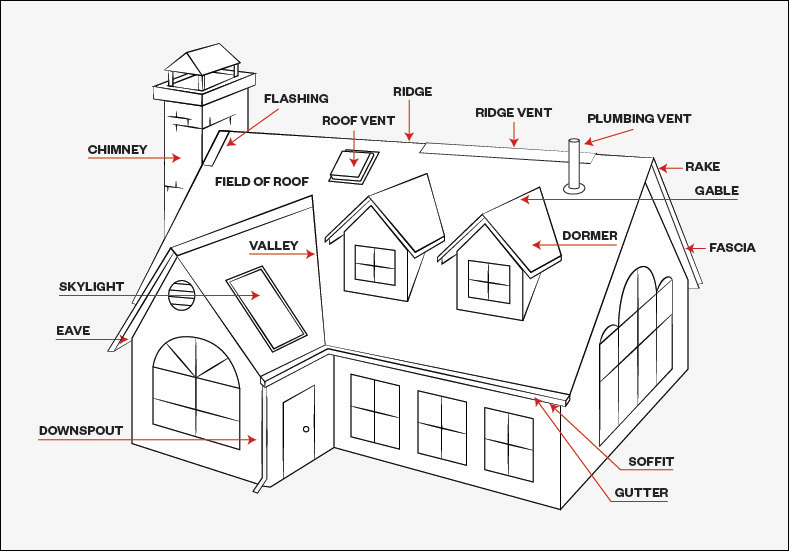
Parts of a roof: Visible

Basic Terminology

Roofs come in all sorts of shapes and sizes, we’re going to begin by explaining each of the terms and describe their essential architectural features.

FIELD OF ROOF: This is the central or main portion of your roof.

ROOF VENT: This allows your attic to ventilate and helps to protect your roof from moisture.

CHIMNEY: This is a ventilation structure that isolates toxic gases from a fireplace, furnace, or boiler from the living space of your home.

DORMER: This is a vertical window that projects from a sloping roof.

SKYLIGHT: This is a window on your roof that allows light to come in.

PLUMBING VENT (VENT STACK): This pipe helps to regulate the air pressure in your plumbing system.

RIDGE VENT: This runs the entire length of your roof. It is an air exhaust vent installed on the peak of your roof.

GUTTER: This is a trough that is beneath the edge of your roof to carry off rainwater.

GABLE: This is where two sections of a roof come together to form a ridge.

RAKE: This is the sloped edge of a roof at or adjacent to the first or last rafter.

EAVE: This is the projecting edge of a roof that extends beyond the supporting wall.

SOFFIT: This is the enclosed underside of any exterior overhanging section of a roof eave.

VALLEY: This is the internal angle that is formed by the intersecting planes of a roof.

RIDGE: This is the horizontal top area where two sloped roof areas meet.

DOWNSPOUT: This is a vertical device that is connected to your gutter to redirect water runoff.

FASCIA: This is a long straight board that runs along the lower edge of your roof.

FLASHING: This is a thin piece of material that will prevent the passage of water into a structure from a joint.

Now that you can understand the basic terminology.

Parts of a Roof: Non-visible Structure

In your roof structure, there are many parts of a roof that you may not be able to see directly. These parts make up the architectural structure and are vital in the construction of the roof.
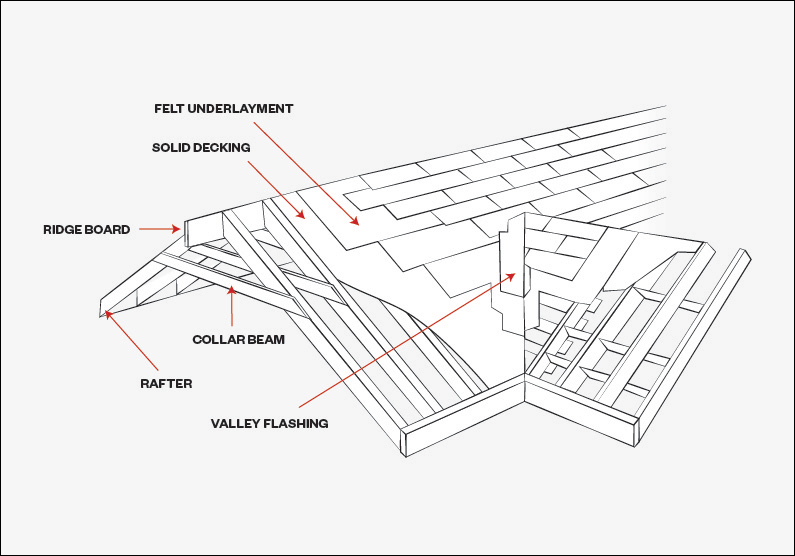
Parts of a roof: Non-visible

Basic Terminology

RAFTER: This is a series of sloped structural beams that extend from the ridge. They are designed to support the roof.

COLLAR BEAM: This is a horizontal beam between two rafters.

RIDGE BOARD: This connects the upper ends of the rafters to form the apex of a triangle.

RAFTER: This is a series of sloped structural beams that extend from the ridge. They are designed to support the roof.

COLLAR BEAM: This is a horizontal beam between two rafters.

RIDGE BOARD: This connects the upper ends of the rafters to form the apex of a triangle.

SOLID DECKING: These are the wooden boards that make up the framing of your roof.

FELT UNDERLAYMENT (ROOFING TAR PAPER): This is a layer of protection installed between the roof deck and the shingles.

SPACED SHEATHING: This is where boards that shingles will be nailed to are spaced apart.

VALLEY FLASHING: This protects the middle section where two roof sections meet and helps to redirect rainwater away from the roof.

Here is section for FAQ, that some homeowners get stumped on!

What are 4 basic parts of a conventional roof?
• Eave
• Gutter
• Roof Vent
• Valley

What are the wood pieces in a roof called?
Solid decking: These are the wooden boards that make up the framing of your roof

What is the trim around a roof called?
Fascia: Vertical roof trim located along the perimeter of a building, usually below the roof level, to cover the rafter tails at the eaves and to seal off the top of the siding along the rake.

What is pointed part of roof called?
Ridge: This is the horizontal top area where two sloped roof areas meet.
A simple, no fuss homeowners guide to inspecting your own roof

Learn more in our free ebook

to learn more about your roof get your free copy of: A Simple, No Fuss Homeowners Guide to Inspecting Your Own Roof 
Hiring a Roofing Contractor Checklist

Hiring a Roofing Contractor Checklist

HIRING A ROOFING CONTRACTOR CHECKLIST

If you are in the beginning stages of looking for a roofing contractor, you have probably noticed that there is a lot of competition to choose from. Your home is an important investment and your roof is protecting that investment. The roofing contractor you choose to hire will determine the quality of work and will dictate if it is protecting your home. Your roof could be damaged from a weather storm, is in need of a repair, or it could at the end of its lifespan – whichever the case this checklist on how to hire a roofing contractor can be used by any homeowner. Here is an easy-to-follow hiring a roofing contractor checklist.

☑ Start out by simply asking them questions about their business, this will give you a sense of their qualifications and experience.
How long have they been in business or years of experience? If not with that company what other years of experience do they bring?

☑ Can they provide references of past projects? Are the photos provided on their website owned by them?

☑ What is the projected time frame of the project?

We will go over the following checklist to follow when hiring a roofing contractor and the importance of each section. As well as the questions and concerns that you should be addressed before the job starts

Hiring a Roofing Contractor Checklistfor small repairs or full roof replacements

Your roofing contractor should be:

☑ Licensed
☑ Local
☑ Insured and proof of liability
☑ Reviewed
☑ Written estimates
☑ Guarantee of work
☑ Warranty
☑ Certified

They are a licensed business

Google them! If they are an accredited business then they will have a Google business account with a permanent address (not a P.O. box), a proper website, and other business listings. Searching online for your roofing contractor can give you an idea of how much effort they put into showcasing their business to the public. If you’re questioning their validity, call the Better Business Bureau, they make certain businesses operate with honesty and integrity.

Local

A local roofing contractor should already know your area and what materials work best in your climate. Choosing a local roofing contractor will cut down travel time to the job site as they can easily transport materials and tools. This will ultimately lower your costs and the project will be completed in a timely manner. A local roofing contractor also guarantees that if or when repairs or updates that need to happen they can come to service the roof.

Insured with workman’s and general liability insurance

Ask to see the contractors proof of liability and WCB insurance and ensure that it is in effect for the length of the project. You can also ask for the name and phone number of their insurance company. In some areas there can be local building codes required and ask what are the intentions of the contractors to follow those codes.

As a rule: reject any contractor without proper and adequate insurance

Reviewed positively by clients

Google lets past clients leave reviews which will give you more information to help make your decision. How have they responded to past reviews and what are the range of reviews they’ve received.

Willing to provide written estimates

A detailed and written proposal in which explains all of the work, proposed materials, and has gone over how payment will be collected.

Words of advice: if a roofing contractor insists that they can only be paid in cash, this can be a sign of an non-accredited business.

Certified to work with the materials for your project while guaranteeing warranty
If the products used are not installed to the specifications of the manufacturer then the warranty could be voided. Ask them why they work with that specific manufacturer.

Work is guaranteed

A reputable roofing contractor will be willing to guarantee their quality of work. This can be found in writing as a warranty for the products they recommend and will hold themselves accountable for any mistakes or repairs that are needed because of their work. If the work is not guaranteed then you may have to pay a more expensive bill in the future if not installed incorrectly.

Warranty

Your roofing contractor should give the satisfaction that they will perform the necessary requirements to install your roof properly. Proper installation is key to ensure to get the limited warranty coverage from the shingles manufacturer.

For example, at Bears Valley Roofing and Exteriors we offer a 10 year labour warranty on all of our installations. We guarantee that our labour is guaranteed for 10 years.

Certified to work with the materials for your project

Ask for their certifications for working with the materials, and how many projects they’ve done like yours before. The roofing contractor should have all the necessary certifications and is committed to ongoing professional training for all their staff.

If you follow this checklist for hiring a roofing contractor, you’ll find someone who is reputable, licensed, insured and qualified for your project. When you choose your contractor based on the items outlined above you can be assured the project will be done to your satisfaction.

Concluding points, another addition that can be added to the checklist but may be difficult for any antisocial folks new to a neighborhood. Ask a neighbor who they chose or go for a walk around see if you see any local signage for roofing companies around your home. If you are new to a city or area, sometimes the best way to find a great roofing contractor is all through word of mouth.

Keep a free short version of this checklist by subscribing to our mailing list:
